


Nov 1st 2026
How We Built a Yellow Beaded Prom Dress That Floats
Inside the Kemedress Workroom
The Yellow Petal Gown: How a Heavy Dress Learned to Float
A pale yellow mermaid prom dress, a crystal-covered bodice and a floating arrangement of organza petals. The original sketch looked effortless. Making every layer hold its shape was another matter entirely.

The finished silhouette: a fitted beaded mermaid gown framed by layers of pale yellow organza petals.
The first sample did not fail in any dramatic way. There was no torn seam, no broken needle, no moment when somebody walked away from the worktable in frustration. We finished it, hung it on the rack, and noticed that the petals — the entire reason the dress existed — simply looked tired.
The large organza shapes had softened into droops. The waistline of the overskirt had rolled inward where it met the beaded bodice. Nothing was technically broken, but the result did not resemble the original sketch. In the drawing, the gown appeared to float.
That word became the real assignment. Almost nothing about this dress is actually light. The bodice carries extensive beadwork, every petal has a shell pearl, and the overlapping organza layers create considerable weight around the waist.
Our challenge was not simply to make a beautiful yellow prom dress. It was to engineer a layered silhouette that could carry its own decoration while maintaining the soft, lifted appearance of a flower in bloom.
The Shape of Each Petal
The overskirt is constructed from large, rounded, spoon-shaped organza panels. Each petal is broad near the top and gradually narrows towards a soft point. From a distance, the shapes appear simple. Their construction is considerably more involved.
We cut each petal in two layers of organza, place the pieces face to face, sew along the curved edge and carefully turn the panel through. This produces a clean, enclosed edge without the visible hem that would interrupt such a sheer fabric.
Turning a delicate organza petal requires patience. We use a proper point turner rather than a pencil or other sharp object. A small puncture in transparent organza can be impossible to disguise, so each panel needs to emerge without damage.
However, a neatly turned petal is still flat. That was the first structural problem. In the original drawing, every petal appeared to cup gently and catch the light. A flat panel could not reproduce that effect.
We introduced a second curved stitching line inside each petal. The first seam creates the clean outer edge; the second gently draws the two fabric layers together, creating a shallow spoon-shaped form. Without that second line, the organza gradually loses its shape while hanging.
The lower curve receives additional hand finishing. We use a narrow rolled edge with silk thread, allowing the organza to retain a softer finish without pulling into unwanted ripples.
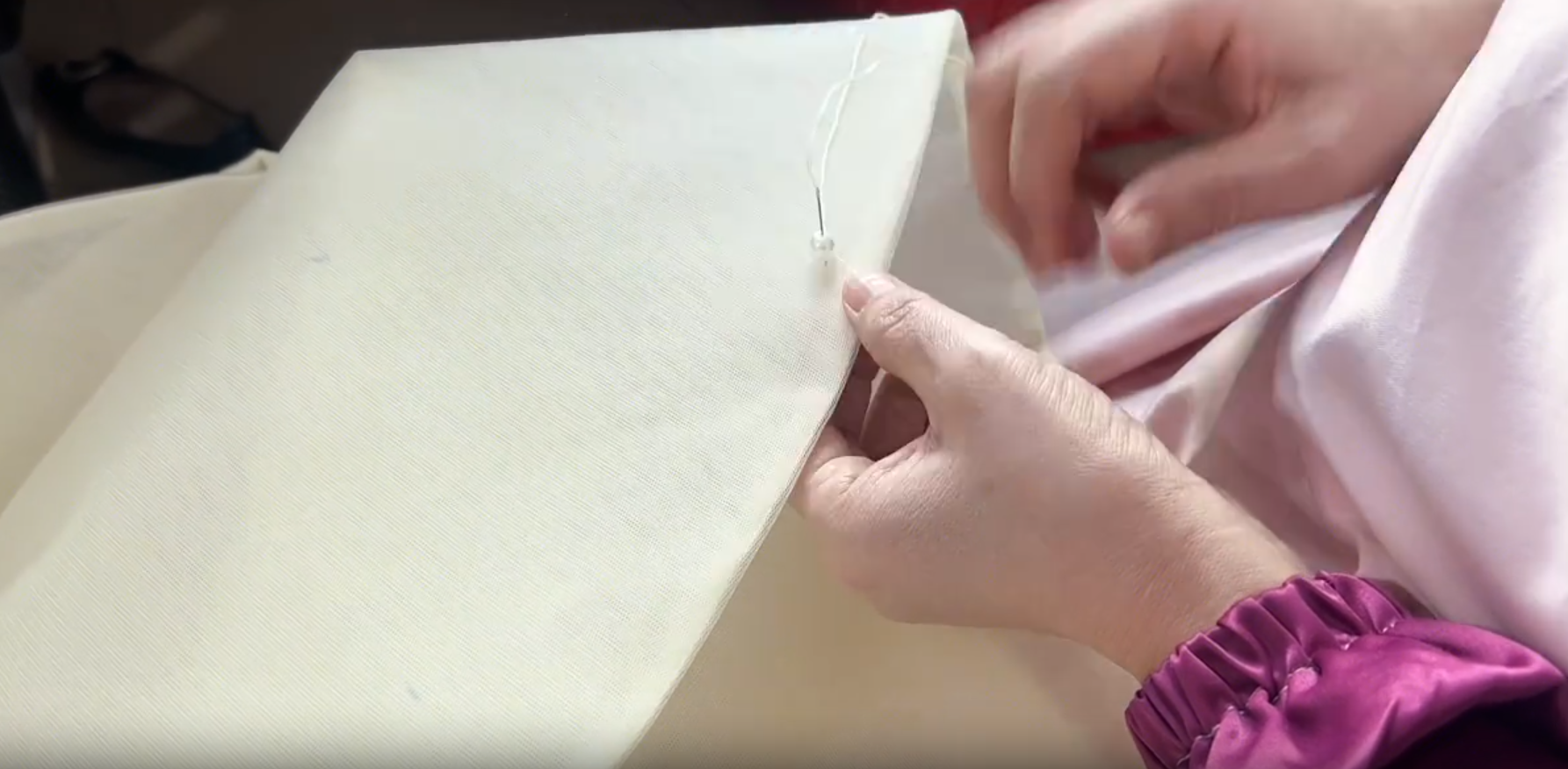
Construction begins with the relationship between the individual petals and the supporting waistband.
The Thirty-Five Pearls
The first batch consisted of thirty-five shell pearls, approximately 8mm in size. We counted them before sewing anything onto the organza.
Pearls seem visually delicate, but their weight becomes important when repeated across several layers of fabric. Combined with the crystal-covered bodice and decorated shoulder puffs, even small additions can change the way an overskirt hangs.
We established one important placement rule: no pearl near the tip of a petal.
The narrow end acts like a small lever. Adding weight there encourages gravity to pull the panel downwards, flattening the carefully shaped curve. Instead, pearls are positioned within the upper two-thirds of each petal, where the fabric has more support.
Each pearl receives its own anchoring stitch using nylon thread. This means an accidental snag can be repaired individually without disturbing an entire line of decoration.
The placement is deliberately irregular. A perfectly repeated grid can make hand-applied embellishment appear mechanical. We mark approximate positions on the paper pattern, then adjust individual pearls by hand while sewing. The overall coverage remains balanced, but the spacing is not identical.
Our first arrangement placed one pearl at the centre of every petal. When six appeared in a vertical line, they looked more like buttons than floral details. We removed them and started again. It cost time, but the revised arrangement gave the overskirt a much more natural appearance.
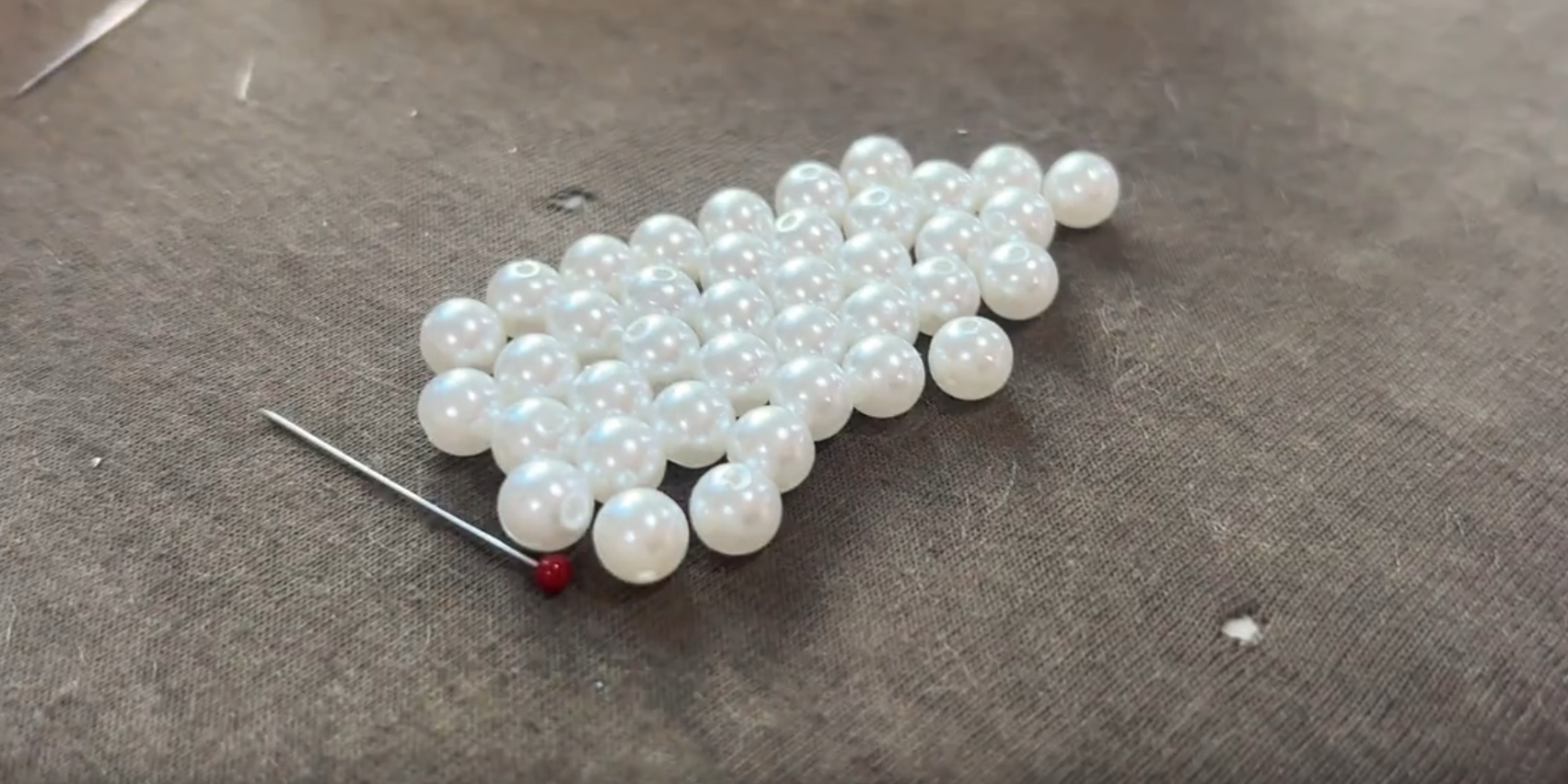
Individual shell pearls are positioned and secured by hand, with careful attention to the weight of each panel.
A Flower Cannot Repeat Itself
The organza petals are arranged in overlapping rows, with each successive row becoming shorter. It would have been easier to repeat an identical arrangement throughout the skirt. We tested that approach on the paper mock-up, and the result looked too mechanical.
Natural flowers do not repeat in perfect rows. Their layers overlap at different angles, creating depth and movement. We followed that principle by tightening the overlap near the centre front and allowing it to open gradually towards the sides.
Each row covers approximately two-thirds of the row beneath it. Too much overlap hides the lower petals. Too little exposes gaps and reveals the waistband underneath.
Before machine sewing, we mark the overlap on the toile and check the arrangement with pins. The measurements are not simply enlarged proportionally for every size. Larger panels change the way the petals meet, so the placement needs to be reviewed again.
The front remains intentionally open. Beneath the petals, the fitted mermaid silhouette and its beadwork remain visible. That contrast is essential to the design: the narrow gown provides the foundation while the organza blooms around it.
We also check the two sides against the centre line. A difference of only a few millimetres can make the overall arrangement appear unbalanced, even if a viewer cannot immediately identify why.

Overlapping rows create the depth and volume of the finished petal arrangement.
The Waistband That Changed Everything
This was the most important correction to the first sample.
Originally, we attached the overskirt directly to the waist seam of the inner mermaid gown. It seemed efficient, but the result quickly revealed a problem. The weight of the organza pulled against the inner dress, placing unnecessary tension around the centre-back zipper and making the waistline feel bulky where several layers met.
We stopped treating the overskirt as a decorative addition and rebuilt it as an independent garment.
The revised design has its own waistband, reinforced with a dense, non-stretch woven stay. This internal reinforcement carries the weight of the petal rows independently. The waistband closes separately and sits around the outer waistline of the mermaid dress.
The principle is straightforward: the inner dress supports the wearer, while the overskirt supports its own decoration.
Every petal row is pinned, measured and checked before machine stitching. We also enclose the raw edges of the waistband so that no unfinished fabric comes into contact with the wearer.
For custom orders, the overskirt can be adapted to open and detach when requested. This allows the fitted beaded mermaid gown to remain a complete dress underneath, rather than leaving an unfinished waist seam when the outer layer is removed.
The independent waistband carries the weight of the layered overskirt.
The Beaded Bodice
The bodice is the heaviest decorated section of the gown. It uses beaded tulle over a satin-backed foundation, with intricate paisley and feather-inspired motifs worked in seed beads, bugle beads, sequins and small pearl clusters.
We pay particular attention to the relationship between the embellishment and the internal corset structure. The bodice is boned, but the decorative motifs do not sit directly over the boning channels.
We learned from previous construction work that rigid beadwork positioned directly over rigid boning can create an uncomfortable ridge and visible buckling across the ribs. Keeping the decorative paths separate from the internal support allows both elements to perform their own functions.
The result is a richly decorated surface with a structured foundation that remains visually quiet.
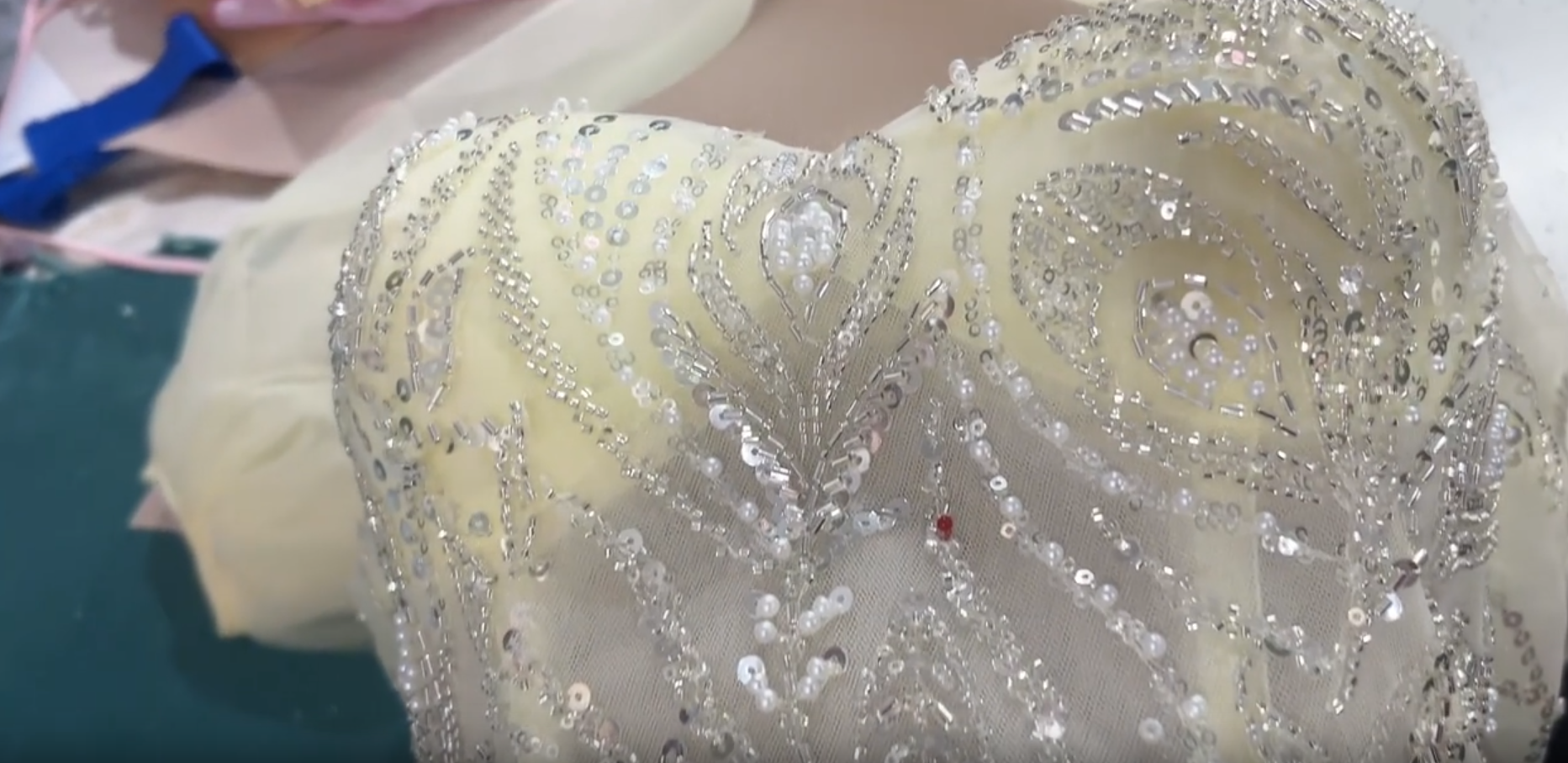
Crystal and beadwork details across the fitted bodice.
The Sleeve We Changed Our Minds About
The shoulder design changed significantly between the original paper pattern and the finished gown.
The first toile included a large, angular bow at the shoulder. On paper, it looked architectural and dramatic. Once translated into organza, however, the shape felt too rigid and competed with the softness of the petal overskirt.
We replaced it with gathered tulle puff sleeves.
The fullness is drawn in by hand before the sleeve is trimmed to its final length. This order matters because gathering changes the position of the seam line. Cutting the fabric to its final length before gathering can leave the finished sleeve uneven.
Scattered crystals on the puffs connect the shoulder details to the embellished bodice. The softer silhouette also gives the off-shoulder neckline a more balanced relationship with the floral overskirt.
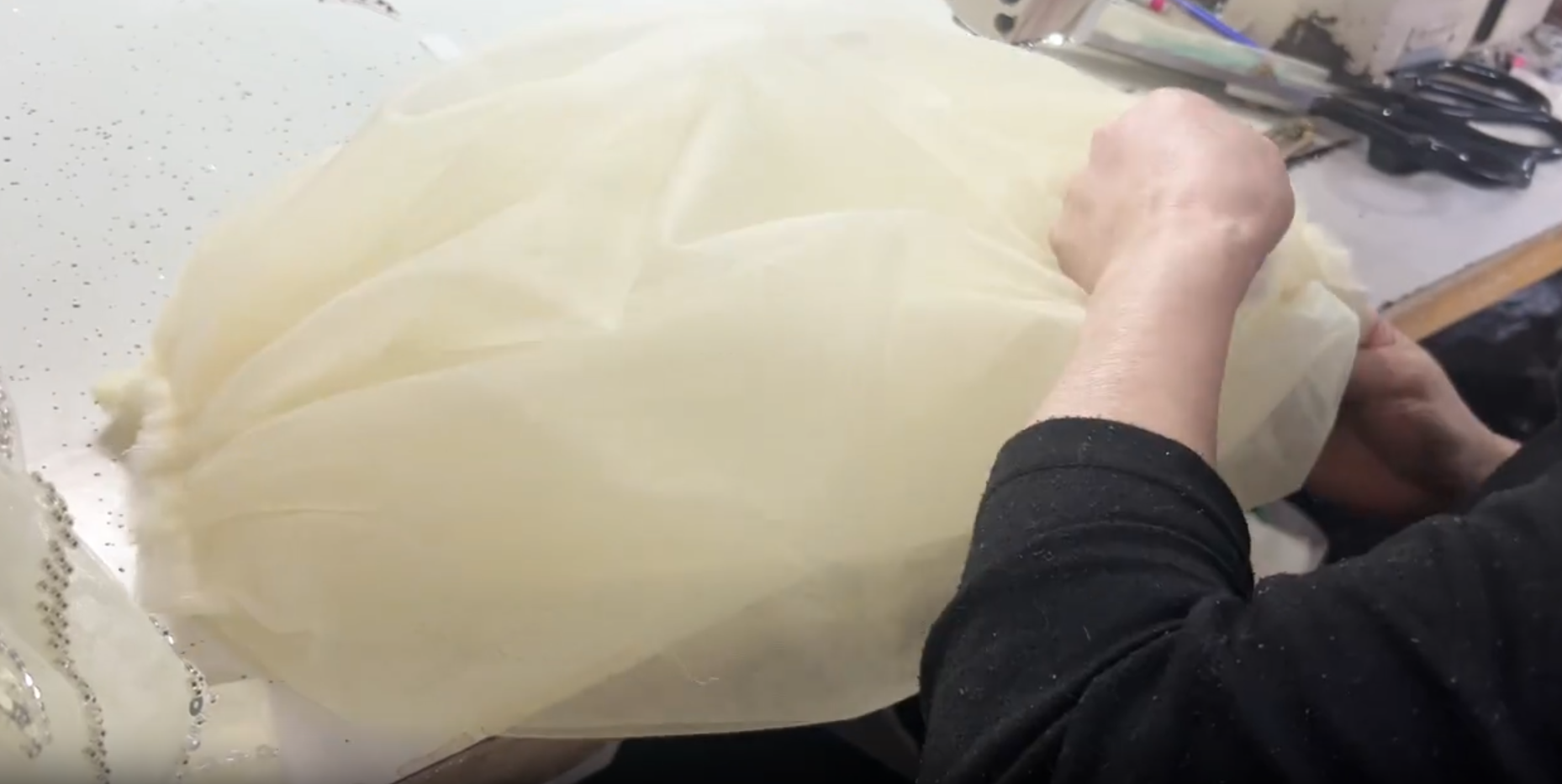
Hand gathering creates the soft volume of the off-shoulder tulle puffs.

The gathered tulle is trimmed only after its final fullness and seam position have been checked.
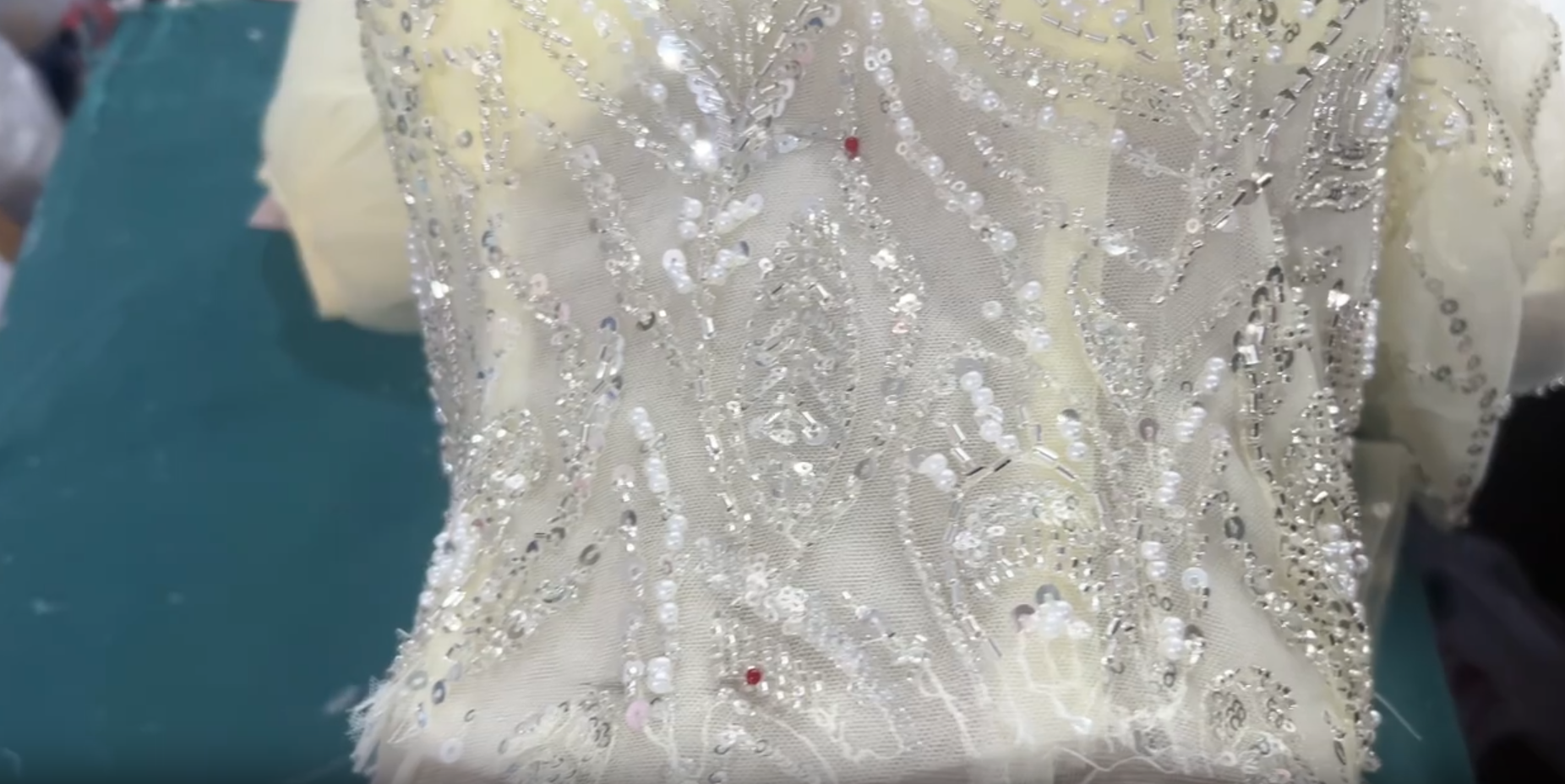
Hand-applied decorative details are checked before the gown moves to final assembly.
Bringing the Layers Together
Once the individual elements are complete, the work shifts to assembly. The bodice, fitted mermaid skirt, petal overskirt and gathered sleeves must work together without creating unnecessary bulk or pulling against one another.
We assemble the fabric sections carefully, checking the seams and the position of each decorated area. Fine tulle needs a controlled feed through the sewing machine. Moving too quickly can stretch the material or disturb the alignment of the layers.
The final inspection also includes checking the beadwork, pearl attachments, waistband closure and the way the petals fall when the gown is hanging naturally.
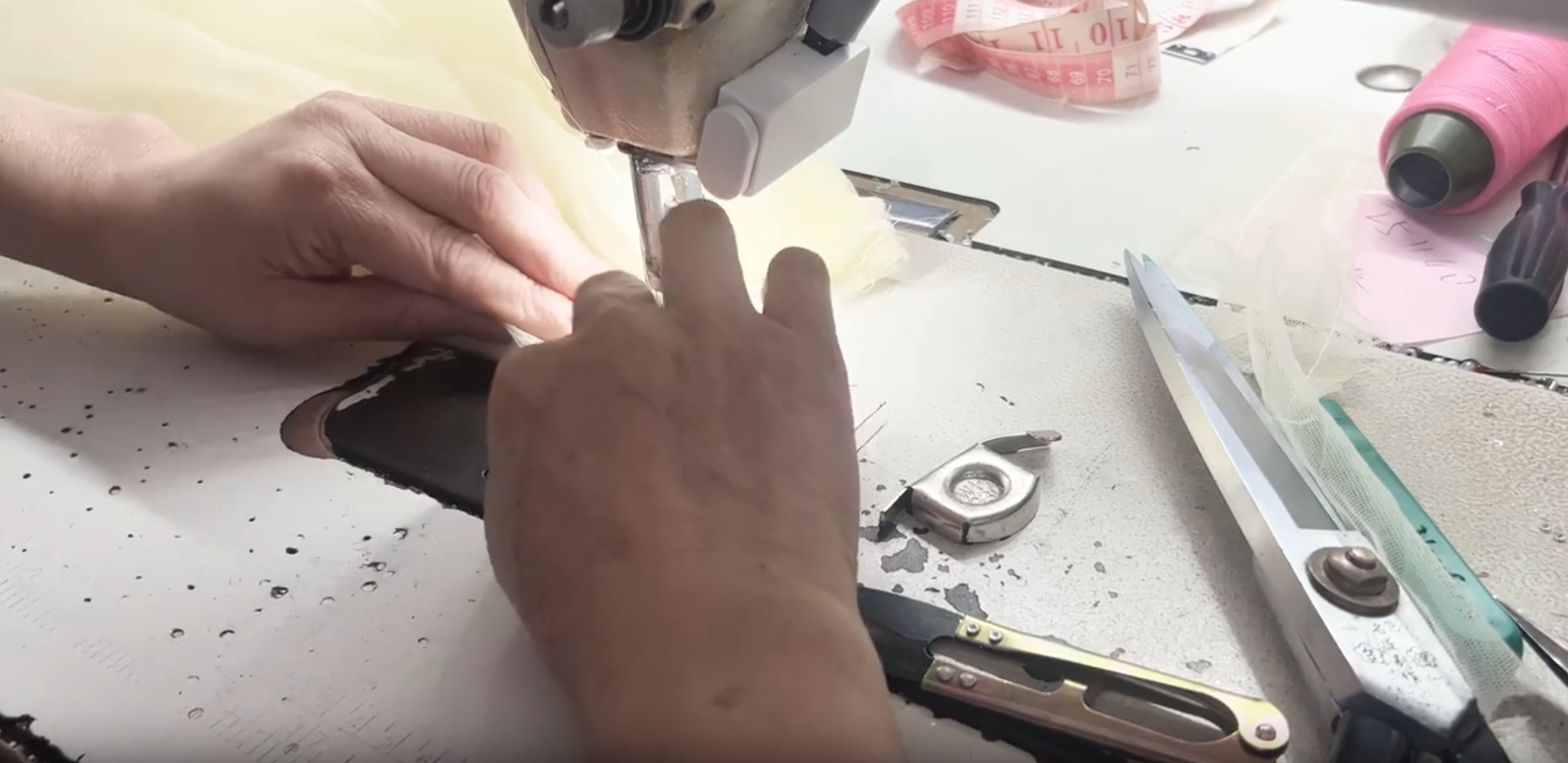
Machine assembly brings the individually prepared fabric sections together.
The Paper Pattern and the Finished Gown
We keep the comparison between the original toile and the completed dress because it records the decisions that actually shaped the final result.
The paper version contains the original angular shoulder bow and the first straight waist construction. Neither survived unchanged. The independent waistband, the curved petal shaping, the repositioned pearls and the softer gathered sleeves all came from corrections made during development.
This is an important part of couture production. A design drawing communicates the intended appearance, but the pattern and sample reveal what needs to change before the garment can achieve it.
The finished gown is not simply a translation of the original sketch. It is the result of testing the materials, identifying structural problems and refining the construction until the proportions work.
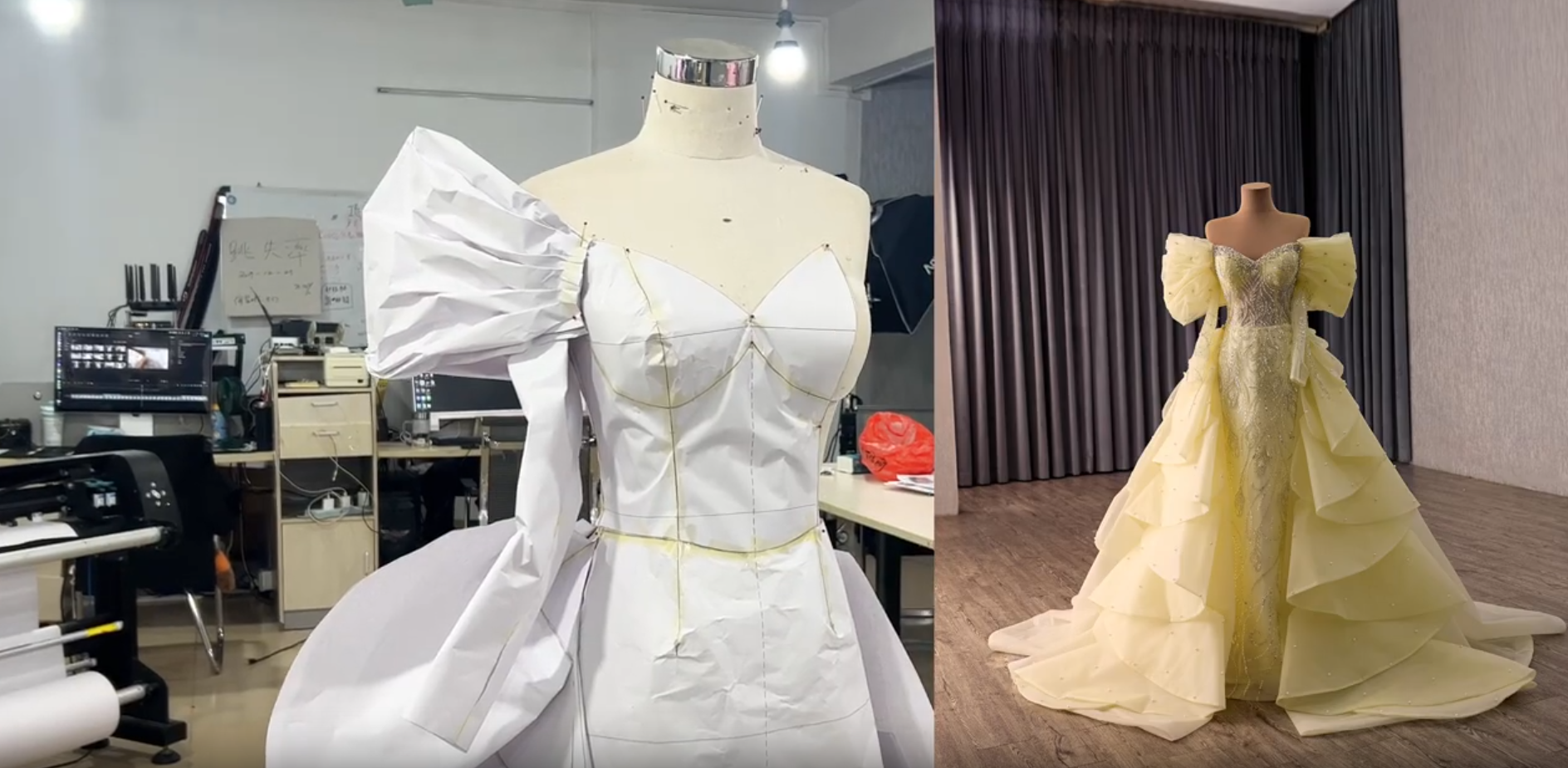
The original pattern and toile beside the finished gown: a record of the changes made during construction.
The Finished Silhouette
A Closer Look at the Gown
The completed dress brings together a fitted crystal-beaded mermaid silhouette, soft off-shoulder sleeves and a dimensional petal overskirt.

Full front view with the organza petal train.
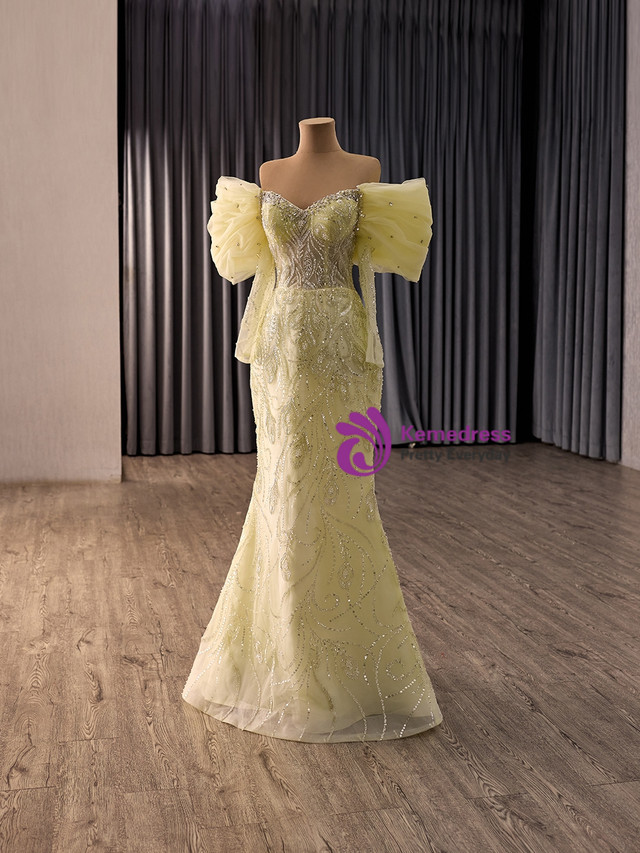
The fitted mermaid silhouette and embellished bodice.
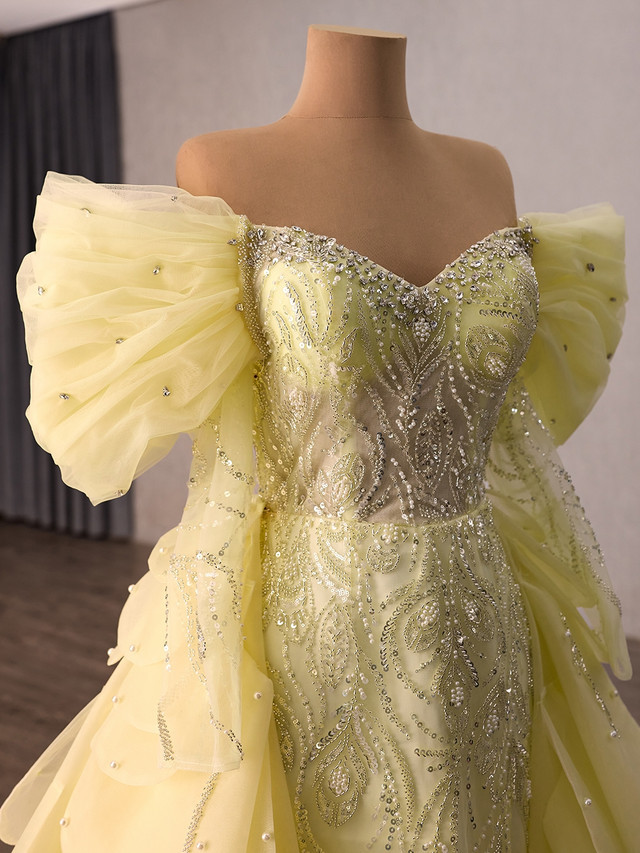
A closer view of the decorated front bodice.
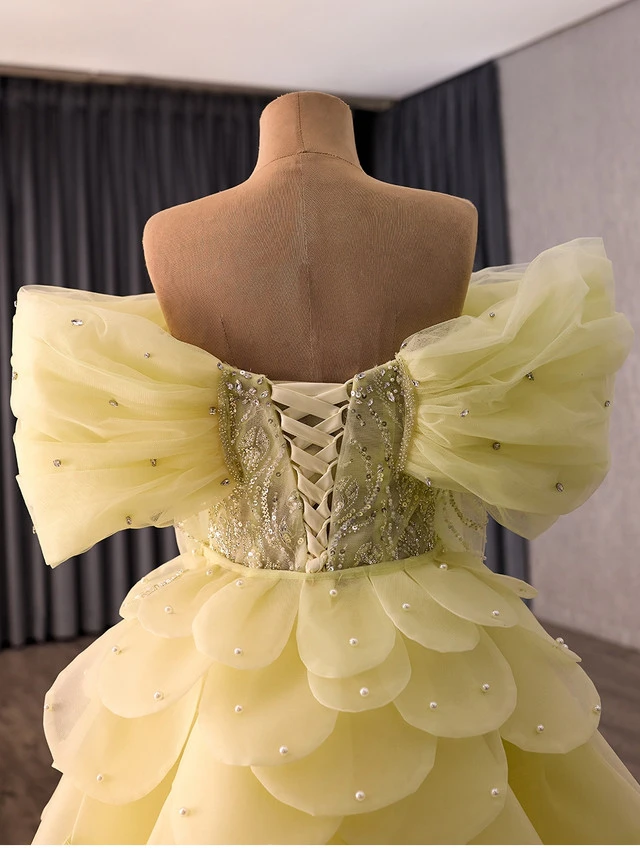
Back detailing and the finished construction.
You can also view the finished gown from behind to see the complete back silhouette and train.
The Finished Dress in Motion
See the Petals Move
The completed pale yellow gown, showing its silhouette, embellishment and movement.
Wearing and Caring for the Gown
A dress with a fitted mermaid foundation and a layered organza overskirt needs a little attention when worn and stored.
- When sitting, gently move the back petals to one side to avoid placing your weight directly on the organza layers.
- After removing the gown from its garment bag, hang it carefully and allow the petals to relax naturally. Persistent folds should be treated with low-temperature steam from underneath.
- Because of the extensive beadwork and shell pearls, professional cleaning is recommended. Tell the cleaner about the boned bodice and the separate overskirt construction.
- For storage, use the inner gown's hanging loops rather than placing the full weight of the dress on the decorative overskirt waistband.
The Design Beyond One Dress
This gown is a good example of the kind of construction work involved in handmade haute couture prom dresses. The visible decoration is only one part of the process. Pattern development, internal support, fabric behaviour and hand finishing all contribute to the final silhouette.
For more designs in this colour family, explore our pale yellow mermaid prom dresses, where soft colour, decorative detail and different silhouettes come together.
The specific gown featured in this story is also available to view here: yellow beaded mermaid prom dress.
For custom enquiries, the details that matter most are the finished silhouette, the desired colour, the way the overskirt should be attached and the fit of the inner gown. Sharing these preferences early helps our pattern makers understand the intended result before production begins.
The sketch gave us the flower. The workshop gave it the structure to bloom.
The finished yellow petal gown is the result of many small decisions: the shape of an individual organza panel, the position of a single pearl, the support beneath the waistline and the balance between a fitted mermaid foundation and a floating outer layer.
At Kemedress, these are the details that turn an original design into a finished couture-inspired prom dress. The most successful construction is often the work you notice least when you finally see the gown moving.
Kemedress Workshop
Designed and constructed at the Kemedress workshop, from pattern development and toile adjustments to hand embellishment and final assembly.